
Lorentz Chair
Lorentz Chair since 1955 2020
Gia Dvali [lectures]
2019
Seth Lloyd [colloquium — poem]
2018
Tom Lubensky [lectures]
2017
Renata Kallosh [lectures]
2016
Charles L. Kane [lectures]
2015
John B. Pendry [lectures]
2014
2013
H. Eugene Stanley
2012
Subir Sachdev [lectures]
2011
2010
Thomas A. Witten [lectures]
2009
2008
2007
Thomas W.B. Kibble
2006
David R. Nelson
2005
Peter Zoller [lectures]
2004
Leonard Susskind
2003
Leo P. Kadanoff
2002
John P. Preskill
2001
Howard C. Berg
2000
Chandra M. Varma
1999
Michael V. Berry
1998
1997
Bertrand I. Halperin
1996
Yoseph Imry
1995
N. David Mermin
1994
Julius Wess
1993
Michael E. Fisher
1992
Alexander F. Andreev
1991
Pierre C. Hohenberg
1990
Bernie J. Alder
1989
1988
1987
Raymond L. Orbach
1986
Philippe Nozières
1985
Ben Widom
1984
1983
Irwin Oppenheim
1982
Léon van Hove
1981
Ryogo Kubo
1980
Anatole Abragam
1979
Ezechiel G.D. Cohen
1978
1977
Victor F. Weisskopf
1976
Rudolf E. Peierls
1975
1974
1973
1972
1971
David Pines
1970
1969
Isaak M. Khalatnikov
1968
Elliott W. Montroll
1967
Christian Møller
1966
Herbert Fröhlich
1965
Wladyslaw Opechowski
1964
Oskar Klein
1963
Mark Kac
1962
Léon Rosenfeld
1961
Elliott W. Montroll
1960
1959
John G. Kirkwood
1958
Walter H. Heitler
1957
1956
John A. Wheeler [reminiscence]
1955
» portrait gallery « of Nobel laureate Lorentz professors
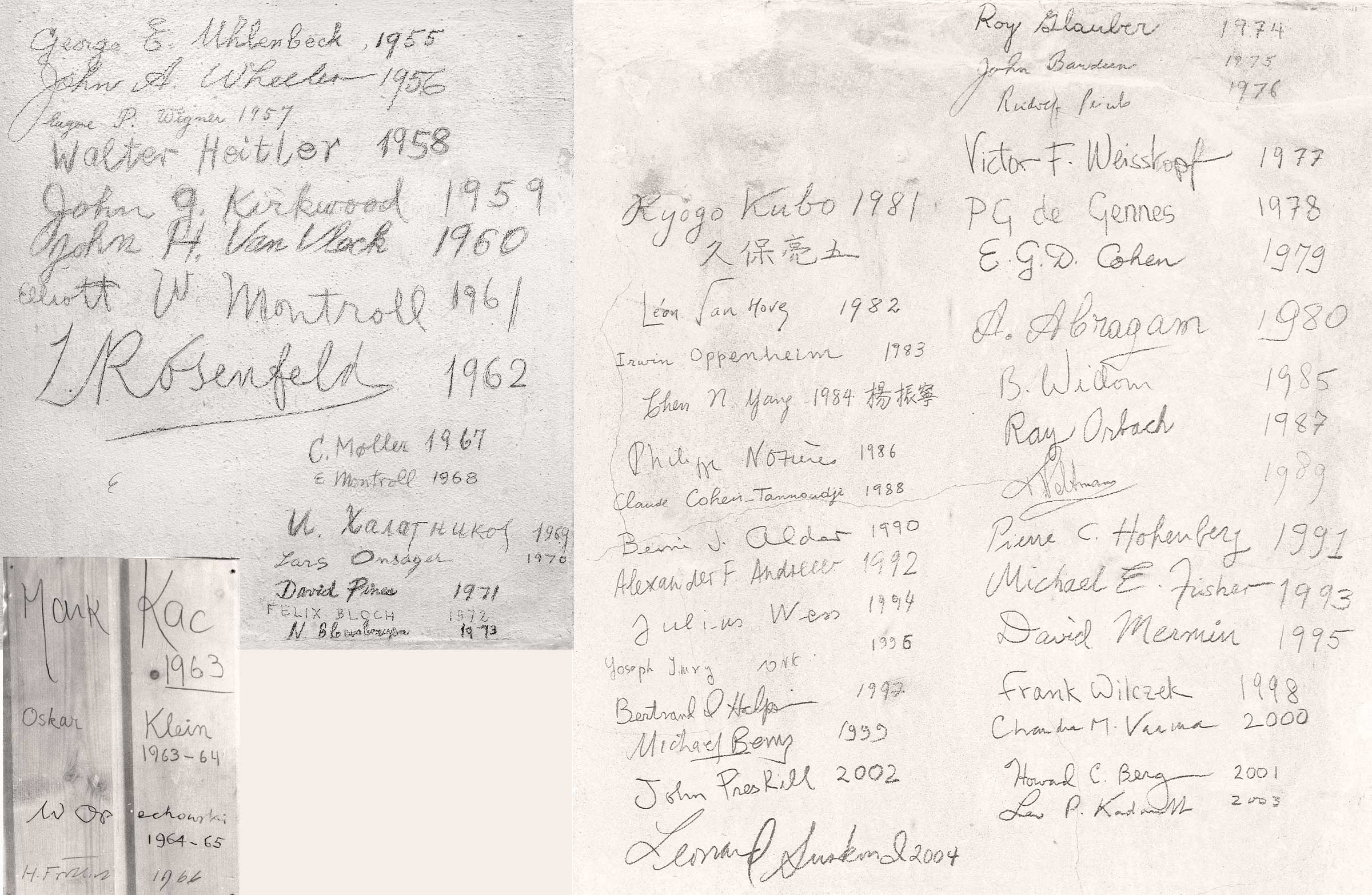
Signatures of the Lorentz professors on the wall of our old colloquium room.
To activate the magnifying glass, reduce the width of the browser window.
![[reminiscence]](wheeler/quotes.png)